
Microsoft opens Project Perception public preview for agentic security teams
Microsoft said Project Perception entered public preview on August 3, moving its new agentic security system from announcement mode into a real customer-access phase. The product matters because Microsoft is packaging AI-driven red-team, blue-team, and remediation loops into one security stack instead of treating agents as isolated assistants.
Opening summary
Microsoft said Project Perception entered public preview on August 3, moving its new agentic security system from announcement mode into a real customer-access phase. The product matters because Microsoft is packaging AI-driven red-team, blue-team, and remediation loops into one security stack instead of treating agents as isolated assistants.
Main article
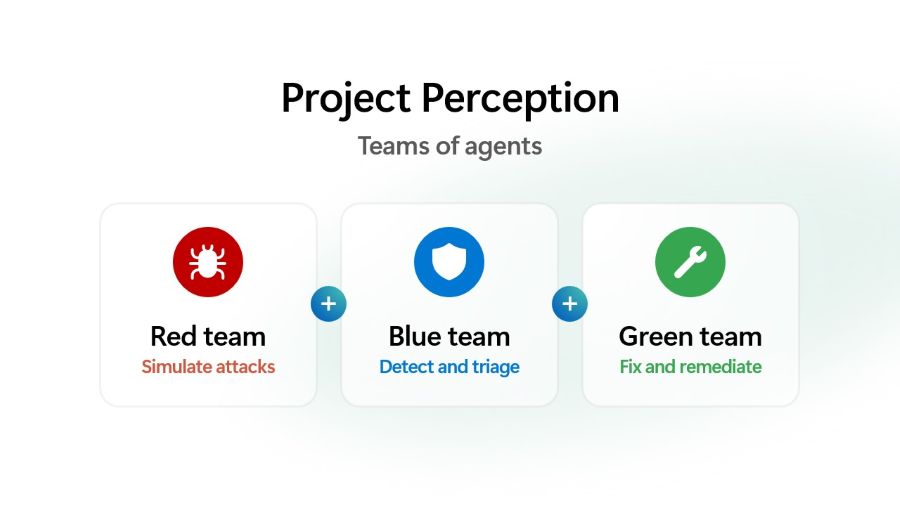
In its July 27 security post, Microsoft described Project Perception as a continuously learning defense system that coordinates red-team agents to find likely compromise paths, blue-team agents to investigate and prioritize risk, and green-team agents to take corrective action. The company also positioned it around a multi-model architecture rather than a single flagship model, arguing that always-on security requires balancing quality, latency, and cost.
Microsoft tied the first major workflow to software-vulnerability management through MDASH with MAI-Cyber-1-Flash, which it said delivers 96 percent on the CyberGym benchmark and roughly 50 percent cost savings versus the current in-market MDASH setup. Reuters follow-up snippets and Verge coverage both reinforced the timing detail that matters for a news publish gate: Microsoft said Project Perception enters public preview on August 3, 2026.
That preview milestone is what turns this from background positioning into a live product story. The enterprise-security market is filling up with AI-security claims, but public preview is a concrete operational step. It signals that Microsoft is ready to let customers test how its agentic security stack works against real environments, integrations, and workflows rather than just benchmark slides.
The bigger competitive angle is that Microsoft is arguing for an orchestration layer, not a single-model winner. In practice, that means the company wants enterprises to buy into a security harness that decides which models and agents should handle which class of task. If customers accept that framing, Perception could become less about one cyber model and more about Microsoft owning the control plane for AI-era security operations.
Why it matters
Project Perception is specific, current, and newly actionable because the preview date has arrived. It also fits GCATS well: it is a named enterprise product, it has a clear operational claim, and it advances the broader story of AI agents moving from copilots into orchestrated infrastructure roles.
Source notes
- Microsoft, "Rethinking security for the age of AI" (July 27, 2026): https://blogs.microsoft.com/blog/2026/07/27/rethinking-security-for-the-age-of-ai/
- TradingView / Reuters brief, "Microsoft Says Project Perception Enters Public Preview On Aug 3" (July 27, 2026): https://www.tradingview.com/news/reuters.com%2C2026%3Anewsml_FWN43T17J%3A0-microsoft-says-project-perception-enters-public-preview-on-aug-3/
- The Verge archive coverage, "Microsoft says its Project Perception AI system can continuously investigate and fix security flaws" (July 27, 2026): https://www.theverge.com/microsoft
- TechRadar Pro, "Microsoft introduces its first agent-powered cybersecurity model and Project Perception AI patching system" (July 31, 2026): https://www.techradar.com/pro/security/microsoft-introduces-its-first-agent-powered-cybersecurity-model-and-project-perception-ai-patching-system-can-it-avoid-making-the-same-mistakes-openai-made
SEO keyphrases: Microsoft Project Perception , agentic security preview , MAI-Cyber-1-Flash